Losing a project folder is more expensive than a month of GPU. Muddy VO is more expensive than a quiet USB mic. Pair with AI music and audio and AI writing for creators when scripts become spoken deliverables. Links are Amazon.com searches (tag v00ko-20); we may earn a commission. Affiliate disclosure.
Why this shelf exists
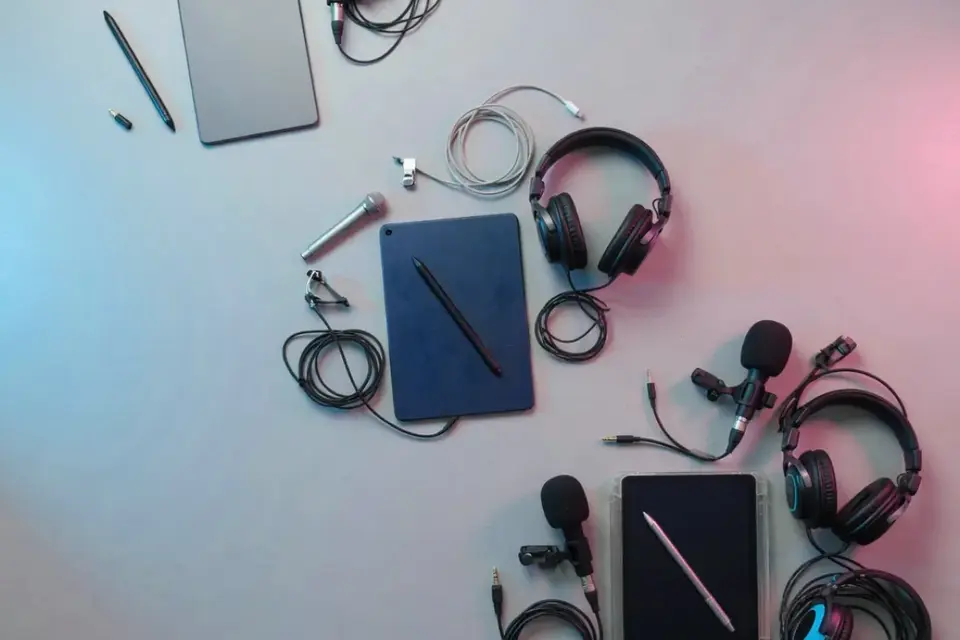
AI music and voice tools are fast. They still dump files — stems, takes, exports, prompt logs, and intermediate video. Two failure modes dominate small studios:
- Unreadable audio — room echo, laptop mic noise, or monitoring on phone speakers that lie about bass and sibilance.
- Vanishing work — one laptop disk, no offload, then a failed clone mid-campaign.
This kit is not a recording studio. It is enough honesty to ship client VO, check mixes, and keep a vault.
The short list
| Item | Why it exists | Skip if… | Search |
|---|---|---|---|
| AT2020USB-X | Cardioid condenser, USB-C, desk stand included. The XP and the USB+ are different listings. | You never record speech; music-only MIDI workflows | Audio-Technica AT2020USB-X |
| Closed-back headphones | Mix checks and VO edits without bleeding into the mic | You already trust calibrated monitors in a treated room | closed-back headphones |
| Portable SSD 1TB | Active vault for current projects + prompt/export archives | Everything already lives on a managed NAS with backups | Portable SSD 1TB |
| Portable SSD 2TB | Video-heavy campaigns, multi-client agencies | You rarely exceed ~400GB of active media | Portable SSD 2TB |
Item notes (why / how / skip)
USB microphone
Why: Laptop mics make every AI voiceover sound like a hostage video. A simple USB mic with a cardioid pattern is enough for scripts, tool walkthroughs, and client delivery walkthroughs.
How: Sit close; treat the room lightly (blanket, closet). Record a 10s noise print. Keep gain out of the red. Name takes project_v01_take02.wav — not Audio Recording 47.
Skip: Pure stills brands with no spoken content; or you already own an interface + XLR and use it.
Closed-back headphones
Why: Open-backs leak into the mic and flatter the mix. Closed-backs let you catch clicks, plosives, and AI music artifacts before a client hears them on a phone.
How: Check mixes at moderate level. Compare once on phone speakers. Do not “fix” with EQ until the edit is done.
Skip: Treated room + honest monitors you already use daily.
Portable SSD 1TB (active vault)
Why: Working projects + exports + a weekly clone of the prompt log. Cloud sync alone is not a backup if you wait for upload on hotel Wi‑Fi.
How: One drive labeled ACTIVE; folder per client/campaign; after ship, move cold to archive. Keep checksum or at least a dated inventory text file.
Skip: Team NAS with versioned backups you actually restore-tested.
Portable SSD 2TB (video weight)
Why: Image-to-video plates, timeline caches, and multiple masters grow fast. 1TB fills during one agency month.
How: Same discipline as 1TB — do not treat “bigger” as permission to hoard unlabeled final_final2 folders. Prefer one master + dated proxies.
Skip: Stills-and-copy shops under a few hundred GB sustained.
Workflow pairing
| Job | Open |
|---|---|
| Music / stems / voice AI | AI music and audio |
| Scripts & VO copy | AI writing for creators |
| Rights before you publish AI voice | Rights & licensing · Commercial checklist |
| Capture / lights | Capture kit |
| Full list | Creator essentials |
Buy order (honest)
- Storage first if you have ever lost a project folder — 1TB portable SSD and a weekly clone habit.
- USB mic the week you sell a VO or publish a talking-head.
- Closed-backs when you notice you cannot hear sibilance or room hiss on phone speakers.
- 2TB when video campaigns are recurring revenue, not a hobby.
Do not stack four mics and a rack mixer because a “creator studio” thumbnail said so. Record one clean FAQ answer, archive it with the prompt log, and upgrade only when the bottleneck is obvious.